
A quiet question about wine, ego, and what truly matters.
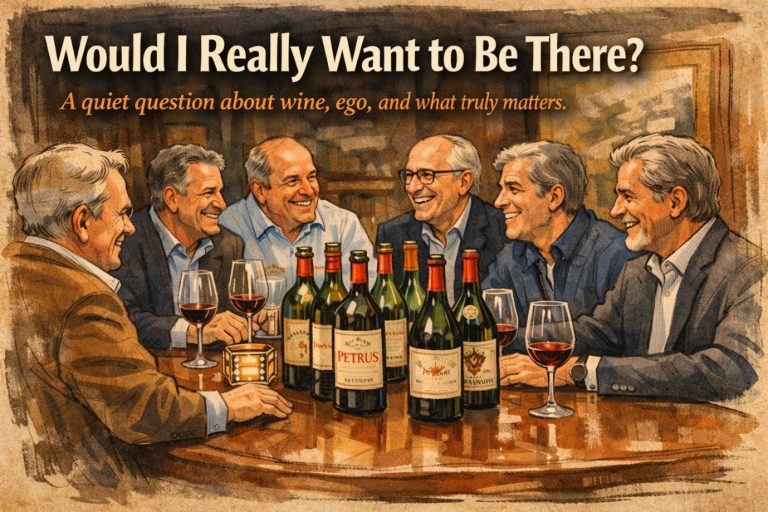
A friend sent me a photo the other day. A table full of men, somewhere between a golf course and a private room, surrounded by bottles of very expensive wine. He wrote, almost instinctively: “Oh my God, you would love to be here.”
And I paused.
Would I?
It felt like such a simple assumption. Of course I would. This is what we are taught to admire, to aspire to. But the question stayed with me longer than I expected.
What does it actually mean – to love being there?
Is it the wine? The rarity? The sense of access?
Or is it something less visible, but more powerful… the feeling of being part of a certain world?
What is really being shared?
I started to imagine what that group was feeling in that moment.
Was it connection? Celebration? Curiosity? Or was it something more performative, each person, in subtle ways, reinforcing a shared language of status, knowledge, and belonging?
The more I thought about it, the more I felt a quiet distance growing inside me. Not judgment. But clarity. Because what I felt coming from that image wasn’t warmth. It felt like ego. A kind of silent agreement of superiority that I no longer feel comfortable participating in.
When you recognize yourself in it
And this is where it becomes uncomfortable. Because I have been there too. There was a time when I also measured value in what I knew, in the wines I had access to, in how many “terroirs” I could name, in how rare the bottle was. And even harder to admit, there were moments when I felt superior because of it.
Today, that version of myself doesn’t make me proud. It makes me reflect. Because I can see how easily my values shifted at that time, not because I truly believed in them, but because I wanted to belong.
And this is where something deeper becomes visible.
In The Rules That Make Us, Oliver Sweet explores how human identity is not formed in isolation but shaped through the invisible frameworks of the environments we enter. Every space has its own “rules”, not always written, but deeply felt. They determine what is rewarded, what is admired, what signals intelligence, taste, or success.
And over time, we don’t just follow these rules. We absorb them. They begin to quietly shape our sense of value. What we pay attention to. What we strive for. And eventually, what we believe we are.
Looking back, I can see how strongly I was influenced by those unspoken structures. In certain wine environments, the rules were clear: knowledge equals authority, rarity equals prestige, access equals worth.
And without questioning it, I learned to play along. Not because it reflected something essential in me. But because it reflected what was valued in that world. And that distinction matters deeply. Because it means that much of what we call taste, identity, or even expertise is not purely individual, it is relational. It is shaped in dialogue with the systems we are trying to belong to.
And I think this goes far beyond wine.
It lives in every industry, every social circle, every definition of success we unconsciously adopt. We adapt to the rules to be recognized within them, and in doing so, we risk drifting away from ourselves.
So, the real question is not only “what do I value,? but also “which rules taught me to value it?”
The emptiness of borrowed success
There have been moments in my life where I moved away from my own values just to fit into certain circles. To feel accepted. To feel “successful” in the way society defines success.
But when I look back, many of those environments felt… empty. The reward was immediate, but shallow. Because the version of success we are often sold – the one built on recognition, exclusivity, and external validation – is, in many ways, hollow.
Ego is seductive. It makes you feel special, untouchable, elevated.
But at the same time, it separates you. It fragments you. It isolates you from others, and from yourself.
When “the best” becomes noise
And I feel like the wine industry, increasingly, is moving in that direction.
It’s becoming a form of social proof, a way to signal success, knowledge, and status, rather than something deeply rooted in culture, people, and meaning.
Sometimes it reminds me of being on a date with someone who only talks about themselves:
“I’m the best at what I do.” “I have the best position.” “I drive the latest car.” “My house is bigger than anyone else’s.”
At some point, it becomes exhausting.
And I can’t help but notice the parallel when I walk into certain wine spaces:
“We have the best vineyard.” “The best vintage.” “The best wine of the year.”
The best, the best, the best.
And when everything is “the best,” it all starts to sound the same. A seamless narrative, designed to feed the same thing: ego.
The infinite game
But ego doesn’t create happiness. It creates comparison. And happiness – real, lasting happiness – comes from something else entirely.
It comes from purpose. From doing something you truly care about. From contributing to something bigger than yourself. From creating value for others, not just accumulating recognition for yourself.
The challenge is that this path is quieter. Slower. Less visible.
Titles, certifications, prestige – they offer quick validation. They belong to a short-term game. But the real game – the infinite one – is about meaning. About alignment. About building something that matters over time.
It doesn’t give you immediate applause. But it gives you something much more important: a sense of worth that doesn’t depend on being “the best” in the room.
A question to sit with
So, I come back to that photo. And instead of asking “Would I love to be there?”, I find myself asking something else:
What kind of spaces do I want to belong to?
Spaces that impress? Or spaces that connect?
Until next time, with love and gratitude, Priscilla Hennekam: Rethinking wine, culture, and the stories we choose to live by.
*************************************************
Priscilla Hennekam is a Brazilian-Australian strategist and communicator, recognized as one of the most authentic and forward-thinking voices in today’s wine industry. She is the founder of the global movement Rethinking the Wine Industry, where she explores the power of collective intelligence and a creation mindset to drive meaningful change.
Working at the intersection of culture, consumer behaviour, and business transformation, Priscilla challenges an industry often shaped by tradition and replication. She advocates for a shift from a reactive mindset — following trends and preserving the past — to a creation mindset, where imagination, curiosity, and intention are used to actively build the future.
Website: https://launch.rethinkingwine.app/
LinkedIn: https://www.linkedin.com/in/priscillahennekam/