Logo

Archive for September, 2010

Wine of the Week: Francois Cazin Cour Cheverny 2008

Fall is almost here and this wine, made from a grape you probably never heard of—Romorantin—is an ideal drink for the season.
Lots of “onlys” here: there are only about 48 hectares of Romorantin in total, only in France’s Loire valley, and amounting to only about 119 acres across 30 domaines. One of the best, proprietor François Cazin picks his grapes entirely by hand, uses gravity only (no pumping), wild rather than cultured yeasts, and bottles without filtering. So, when he gets a good crop, he gets great wines, but with so little manipulation, that’s not every year.

Cazin’s white Cheverny is a blend of 70% Sauvignon Blanc and 30% Chardonnay, but the Cour-Cheverny by definition is 100% Romorantin. His 2008 offers lemon, ginger and pear aromas with a crisp, bracing backbone, and it’s a little unctuous like a Viognier with a touch of apple-y sweetness and honey notes.

It ain’t easy to find, but good stores in larger cities will have it or can get it for you.  Around 20 bucks and well worth it.  Bring on the pumpkins.

Oh, and sorry – but the full name is Francois Cazin Cour Cheverny Vendange Manuelles Le Petit Chambord 2008.


Fun Wine Facts

There are about 20 million tons of grapes planted worldwide, making it the largest fruit crop.
 
The average grape cluster contains 60-80 grapes. It takes four clusters to make a bottle.
 
There about 40 clusters per vine, and each vine produces about 10 bottles. 
 

Each acre of vineyard produces, on average, 4 tons of grapes.  Some, though, produce as little as 1.5 to 2 tons. In a few places, such as California’s Central Valley, yields of 12-14 tons per acre are not unheard of.  

Each ton of grapes produces, on average, 150 gallons, or 63 cases, or 756 bottles.  Thus, you get about 3024 bottles to an acre.

It takes about 16 pounds of grapes to produce a gallon of wine.

Each barrel contains enough wine to produce about 60 gallons, 25 cases, or 300 bottles.

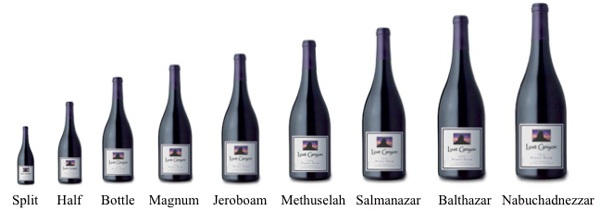
We typically think of wine bottles as the standard 750 ML liter model. But they actually come in many sizes with unique names:

  • Magnum (1.5 liters)  2 bottles
  • Jeroboam (3 liters)  4 bottles
  • Rehoboam (4.5 liters)  6 bottles
  • Methuselah (6 liters)  8 bottles
  • Salmanazar (9 liters)  12 bottles
  • Balthazar (12 liters)  16 bottles
  • Nebuchadnezzar (15 liters)  20 bottles