Archive for May, 2009
I had two experiences in one week that demonstrate both how good and bad restaurant wine service can be, and how you gotta pay attention if you want to avoid paying for Margaux but drinking Boone’s Farm. It’s unfortunate that this nonsense still goes on…and on.
The good was La Griglia restaurant in Kenilworth, New Jersey. While perhaps not the nexus of haute cuisine, this pleasant establishment has an extensive wine list, running to 34 pages and naturally focused on Italy. It features dozens of wines under $100, many of those in the $30-$70 range and a nice selection of new world offerings. I found quite a few things to like, one of which I ordered, Bastianich “Vespa Bianco” 2003, a blend of Chardonnay, Sauvignon and Picolit: complex, savory, forty-seven bucks and done. Good food, crisp and professional wine service, nice glassware, fair prices and lots of choices. Outstanding. And every wine I asked about (eight) was in stock – in the listed vintage.
The bad was the total disappointment of The Would, a restaurant in the lower Hudson Valley, NY. It had been recommended by the concierge at the B&B where we stayed while touring some small wineries in the area, along the Shawangunk Wine Trail.
Anyway, after we arrived and once I got past the fact that the place was still gaudishly festooned with Christmas decorations at the end of January, I plunged into the wine list and immediately saw several things that caught my eye. One, a 2001 Rudd Cabernet, seemed like a good deal, especially after having visited Rudd and tasted their stuff the summer before as part of a class at…the Rudd Wine School of the Culinary Institute of America, Greystone.
I made a point to tell our server to kindly check the vintage (year); she came back a few minutes later and said we were in luck, one bottle left of the ’01. But after departing to fetch two glasses of a nice sparkling Rose as our starter, she returned to tell me the vintage was not ’01 but rather 2002.
I responded by saying, ok, well what’s the price for the oh-two? “Oh, the same” she said. “How is that?” I asked. No answer, and she turned on her heel and trotted away. When she finally returned, I made another selection from the list, only to learn that “we’re out of that vintage” but “we have a different year.” This happened again…and again. When I politely (well, probably with more than a little irritation in my voice) noticed that it seemed to be the rule at this restaurant not to have anything that was actually on the card, the server shot back “it’s just too hard to keep up the list.”
No, it isn’t.
Simply put, a restaurant that actually charges money for wine on their list (as opposed to giving it away) needs to sell what’s actually on the list at that price, not merely what’s in their cellar. Otherwise, ethics requires them to change the list to match what they have in stock, along with an appropriate change to the price. Anything else is simply dishonest.
Now, is this a crisis on par with, say, the swine flu pandemic (which threat is pretty exaggerated itself), or the economic crisis we all face, or, as the nuns used to say, a busload of orphans driving off a cliff? Well, no, but it’s pretty close to stealing, and is a bit of a pandemic itself in restaurants. So as wise wine consumers, you have to pay attention when you’re looking at the list and ask questions, and when the wine arrives, pay attention to what’s on the label. For getting the best from restaurant wine service, go here.
For the record, I made a phone call about this to one of the partners of The Would, and also sent her an email. Remarkably, she didn’t respond to either.
So I have.
So how’s that glass of Seyval Blanc I just poured you? What d’ya think of that Baco Noir? Care to purchase another bottle of Norton? It’s on special today only.”
You’ve probably never heard these words, unless, perhaps, you live in New York’s Hudson River Valley and you get out a bit. And if you want to expand your tastes and wine experience a bit, here’s a primer to get you started.
Seyval Blanc is a French-American hybrid that’s a little reminiscent of Sauvignon Blanc, and can produce outstanding, crisp dry white wines as well as slightly sweet ones. When mixed with Chardonnay, as they do very well at Baldwin Vineyards with their Mist de Greco, or Clinton Vineyards where they do a 100% Seyval, it’s a nice change from the whites you probably drink frequently.
Baco Noir is another hybrid, this time a red, that produces a foxy, smoky varietal a bit like Charbono, another grape you may not know. Benmarl in upstate NY makes a great Baco as does Canada’s Henry of Pelham Family Estate, shown here.
Norton, which was introduced to the US in the 1830s by one Dr. Daniel N. Norton of Richmond, Virginia, is sometimes called “America’s True Grape.” They make very nice wine from Norton in New York, Virginia (Chrysalis Vineyards), Illinois, and especially in Missouri where it’s the popular state grape. Bet you didn’t even know that Missouri had a state grape! Try the Stone Hill Winery for this one, too.
And I’ll throw in a couple from across the pond, too.
Savagnin is a European white grape that can make an aromatic, sherry-like wine and is widely grown in the Jura region and often bottled as Vin Jaune or “yellow wine.” The nutty taste is unmistakable and makes a great aperitif before dinner in place of cocktails. Look for the place name of Arbois where it’s sometimes mixed with Chardonnay and gets a little closer to table wine.
Picpoul Blanc (Picpoul de Pinet) is a white grape and one of the few grown in France whose wine is named for itself rather than the place where it’s grown. Its name means “lip stinger” and it really is, with crisp citrus and floral flavors that go great with seafood.
So – expand your horizons and try some of these!
(Robert Mondavi died just about one year ago.)
It should have been wonderful: a trip to Washington and a state dinner with Jack and Jackie Kennedy!…all while flying the flag for the family’s Charles Krug Winery.
Robert Mondavi had been representing the winery for some time as general manager and head of sales and marketing. As part of his business education, he and his wife Marjorie had traveled to France in 1963 and brought back some new ideas. Not just about making wine, mind you – for example, using oak barrels for aging – but also about the appeal of a more European lifestyle, including fine food and, well, “high culture” at a time when Americans were eating Swanson dinners off trays and washing them down with colas. Bob, as he “modestly” liked to be called, now began to insist on plowing Krug’s profits back into the obsolete winery.
Krug would forever throw off the making of cheap ‘plonk’ and become a world-class winery in its own right. Bob was, back then, what we would later call a ‘visionary’ in the Internet age. Bob’s brother Peter Mondavi had different ideas. As the winemaker, he felt that every “suggestion” his brother made – about wine styles, fermenting techniques, the need for aggressive promotion and marketing, and even sharing ideas with competitors – was an implied, if not explicit criticism, of him. And Peter and his wife, along with his two sisters and their families, also felt strongly that more of Krug’s profits belonged in their pockets.
Still, Marjorie couldn’t stand in the presence of the President of the United States and his ultra-glamorous wife in a house frock, especially when the president of Italy was being honored, could she? She needed a mink, of course. And since this was really a business trip – the Mondavis were representing Charles Krug, after all – shouldn’t the winery cover the cost until Bob could pay it back? As it happened, the trip didn’t take place until early 1964, for a state dinner under a decidedly less elegant president named Johnson.
Peter’s anger and resentment simmered for another year as Bob’s spending and his sometimes high-handed running of the business continued. One afternoon, the brothers began to argue again about Bob’s purchase of the mink for Marjorie. Words turned to fists, Peter found himself on the ground, and a few months later Robert found himself out of a job – fired by his mother Rosa, alienated from his family, and suddenly removed from the only life he knew.
That day, the Robert Mondavi Winery was born.
On Friday, May 16, “Bob” left us. But in the intervening 43 years, he set California winemaking, and wineries in Napa especially, on a course to become much better than they ever would have otherwise. Some say that in pursuing his vision he tore his own family apart in almost exactly the same way he and his brother had parted. And though he and Peter would reconcile in his final years, the inland empire Robert built, with an iconic mission-style winery as its emblem, fell to a corporate wine giant in 2004.
Robert Mondavi was both a simple man and a titan, and full of contradictions. Generous to a fault, his quest for perfection became an obsession that sometimes clouded his judgment and complicated his family life and his business in ways we can only imagine.
Yet he did far more than put his own personal stamp on the outstanding wines that bear his name. His legacy is a steadfast encouragement and personal support of two generations of winemakers, who collectively elevated American wine and the California wine scene to the world-class status for which he yearned.
In this case, “Mission Accomplished” is actually an understatement.
When you’re having a party, it’s easy and fun to buy some less-expensive wine and serve from decanters, which you may already own. You can get a basic but elegant Riedel Cabernet Decanter (shown here) from Target under $20, and many wine retailers sell decorative decanter tags that you can use to label them.
So decant a white, two reds – a Merlot and a Zinfandel, for example – and let your guests pour for themselves. Do make sure your decanters are immaculately clean and rinse them with very hot water to eliminate any soap reside.
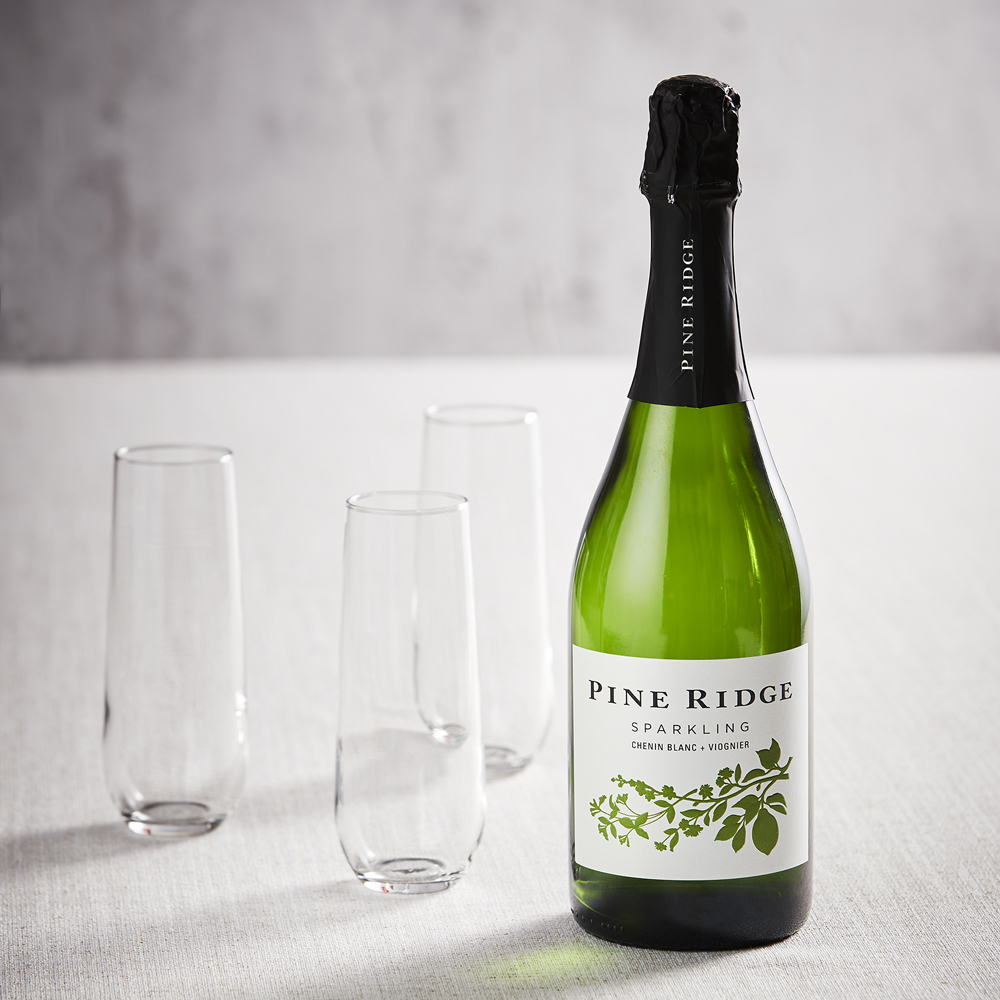
Second suggestion: Get some good bubbly that isn’t “Champagne.” Prosecco is my favorite among the non-Champagne sparklers, and good bottles often go for no more than $12, some even cheaper; for example, Zardetto Conegliano Prosecco can be had for $10 and I’ve seen it as low as $6.
Or try a Spanish Cava – Cava Jaume Serra Cristalino Brut or Aria Estate Cava Brut. Or a French sparkler – Boyer Brut Blanc de Blancs NV, which Sherry-Lehman in NYC carries for $11, or even a nice Rose such as Louis Bouillot Cremant de Bourgogne Rose which goes for under $15. On this side of the ocean, try Barefoot Cellars Bubbly Brut (CA) for under $10, or Chandon Riche California Sparkling Wine or Piper Sonoma, Blanc De Noir, both under $15. If your retailer isn’t carrying sparkling wines at these prices, let them know you’d like them to, and that you’ll go elsewhere if you have to!
Third: Get some good bubbly that is Champagne…but not expensive. Try Charles Lafitte Brut Prestige or Gosset Grand Reserve, both $15-18 max. Or Pommery’s ‘Pops’ Champagne Rose for under $14! Again, tell your retailer to get with these recessionary times!
Finally: Put on a wine-tasting party and ask each guest to bring a bottle of his or her favorite but absolutely under $15. Assign a country (France, US, or Australia for example) or a varietal (e.g. Cabernet Sauvignon, or Riesling, or Sangiovese) or just a vintage year (2006 maybe) and see what turns up. Have each guest introduce their wine and say what they paid and where they bought it so guests who like it can get some, too.
Wine, I mean.
Natalie McLean is a damn good writer and knows her way around a bottle and a vineyard or two. I recommend her Red, White and Drunk All Over as a fun and educational book, and unlike talk show hosts, I actually read the whole thing and am not working from the Cliff’s Notes version hastily written by an intern who’s been up all night turning pages. Gee, I wish I had an intern.
Anyway, good as Natalie is, I disagree with her when when she says (on her website) that every wine lover should have a “house wine.” In my experience, that’s precisely what people who are new to wine get wrong, and what often keeps them from learning about new wine places, varietals and styles.
Is there anything wrong with enjoying a particular wine, and keeping several bottles of it on hand for guests and gatherings? No. But I can’t tell you how many times I’ve visited friends and been “treated” to the same Merlot from the same winery – their “house wine.” When they visit, they are gracious enough to bring wine as a gift, but guess what they bring? Gee, thanks, what a surprise – twice in one week!
Now I’m a big fan of Merlot-based wines, especially those from St. Emilion and Pomerol, and anyone who’s tasted a Chateau Angelus sure knows what I mean. And I’ve even been known to enjoy a glass of California Merlot from time to time. But it’s just one grape in the pantheon of reds, and while my well-meaning friends are happily numbing their palates, they’re missing out on so much. It’s just too easy to stay with one varietal and one winery once you get comfortable with them, like a worn out couch…or husband. But it’s not much fun.
So here’s a short list of what you’re missing:
Cabernet Franc: As a varietal it can be wonderful, with vegetal notes in a cherry wrapping. Try Lang & Reed.
Carmenere: Almost unknown here, they do great things with this smoky, leathery grape in France and Chile, and nowadays even California. Also known as Grand Vidure.
Charbono: Obscure grape that they’re still making into a varietal in north Napa. Try Summers Estate Winery.
Grenache: So delicious as the base of French red Chateauneuf du Pape wines. White Grenache is the base of the white ones.
Mourvedre: An intense, tannic and gamey grape that originated in Spain. Can stand alone but is most often used in blends. Also called Monastrell.
Norton: A native North American grape that can produce a spicy, raspberry-y red. Try Augusta Winery.
Petit Sirah: Not the same as Syrah, and makes a fabulous varietal every bit as big and bold as a cult Cabernet. Try Pedroncelli.
Pinotage: A South African cross of Pinot Noir with Cinsault.
Sangiovese: Base for Chianti wines. When blended with Cabernet and/or Merlot, these are the so-called “Super Tuscans.” A clone of Sangiovese goes into one of the best wines of the last 10 years, the Casanova di Neri Brunello di Montalcino Tenuta Nuova, which got an unheard-of 100 points in 2001 from Wine Spectator, and was its “Wine of the Year” in 2006.
Tempranillo: Spanish grape, main part of Spanish Rioja red wines and goes into Port under the name Tinto Roriz.
Tannat: From the French Madiran region. Intensely tannic wine that can cellar age for decades.
So: love your house wine, if you have one. But step out on it frequently. You’ll be glad you were unfaithful.
I built this website to help you de-mystify the world of wine, so that you can try new stuff at your local retailer, or order confidently in a restaurant. And this little article should also give you some gumption when you attend your first, or 20th, wine tasting.
So – you’re invited to a formal wine tasting…and you want to go. After all, it’s for a worthy charity that you know, and the buzz is they’ve got some wonderful cult California reds and brilliant French white Burgundies. Yum. So you register, and pay your $75, and you show up with excitement and anticipation. You’re relatively new to the world of wine, and the only “tastings” you’ve ever attended are at a friend’s house. And we all know that those were really more like wine “drinkings,” also known as “parties.”
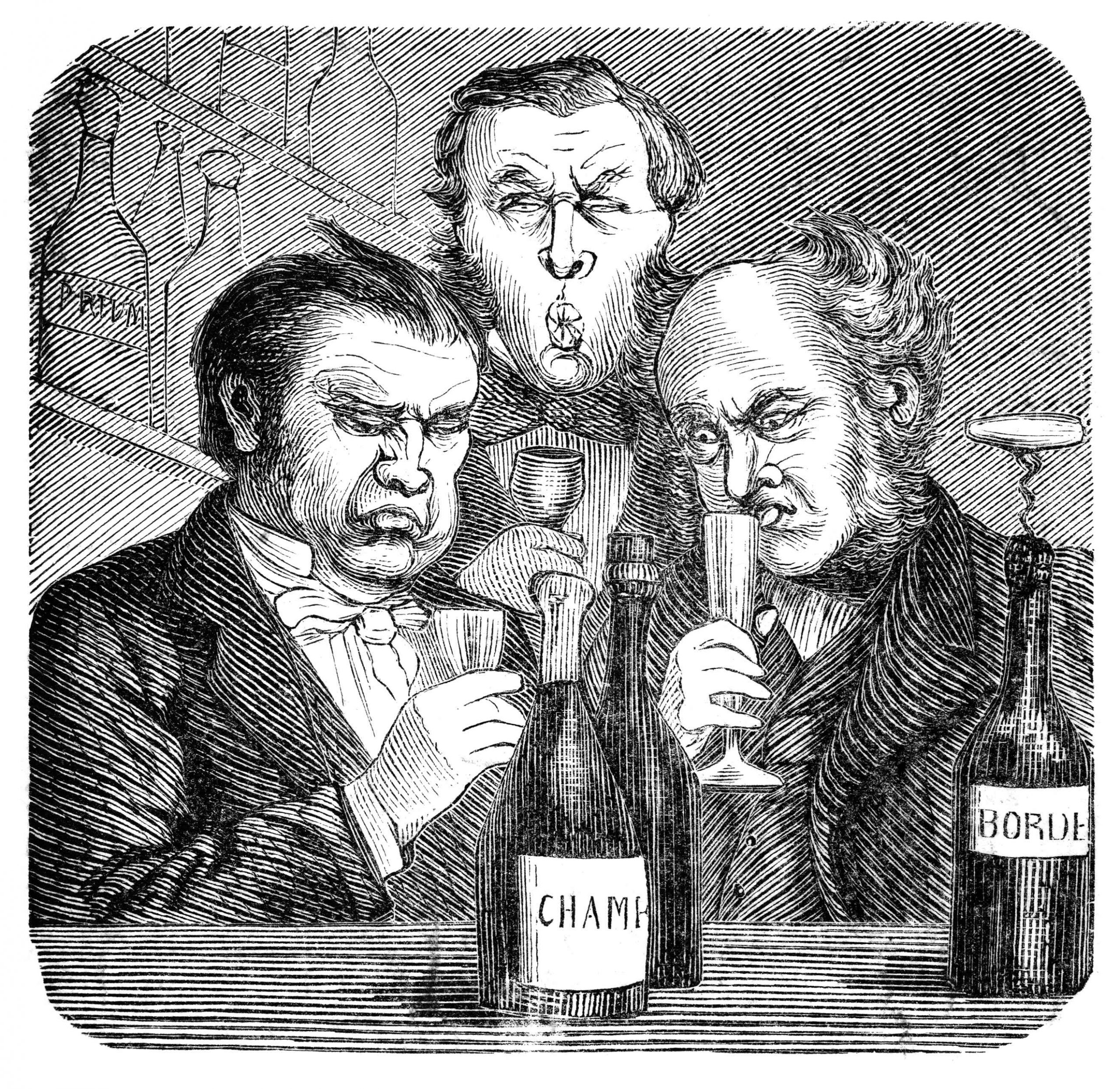
So when you stand outside and gaze into the tasting room, you feel overwhelmed as you watch the light reflect off hundreds of freshly washed glasses, while the assembled guests preen and prance around like masters of the universe. This is supposed to be fun, right? But all you see is very serious-looking people having what look like very serious conversations with well-dressed men and women standing behind tables, carefully pouring a small sample into each glass. The guests hold their glasses up to the light very deliberately, and then swirl them with great ostentation before sticking their noses in so deeply that you think they’ll break – the glasses, their noses, or both. You hear one say something about the “mid-palate” and another remark that “too much time in 100% French is obvious.” Some guests even have those little shiny “tastevins” around their neck, while the prettiest woman in the room is spitting into a ceramic bucket from three feet away with the accuracy of a Marine sniper.
Aside from all these affectations of wine tasting, you think to yourself “I’m not really experienced or very good at this…and what if one of the wine suppliers asks me to describe their product wine in ‘wine terms’ – I will literally shrink to the floor!” You assume that the palates of these critics – and their tastes in wine in general – are so much more “refined” than yours, that you’re simply out of place here.
Well, don’t, and, you’re not.
Why do I say that? ‘Cause in 2001, a professor at the University of Bordeaux conducted two wine tasting experiments that show just how much we are all influenced by pre-conceived perceptions. In the first of his two, well, scams, Professor Frederick Brochet invited a bunch of self-anointed wine experts to describe the flavors and aromas of both red and white wines he poured. One of these high priests lauded the red for its “jamminess,” while another talked of its “crushed red fruit.” None of the almost 60 experienced tasters figured out that the red was really a white wine, tinted darkly with food coloring! The second test with a different group was even sneakier, in which ordinary and inexpensive red table wine was placed in a pricey Grand Cru-labeled bottle, and also in its original labeled bottle.
In other words, a single wine was passed off as itself - and as a different, far superior wine. Yet three-quarters of the experts there judged the “grand cru” as “complex, balanced and rounded,” while the vin de table in their view was “weak, light, flat and faulty”.
But they were the same wine!
My points here are simple:
Real quick:
1. There’s a new Search tab up top to help you find content. Use it – please!
2. Content on this front page will move to an archive folder after a week or two. Scroll down the right sidebar to “Previous posts.”
3. New material in “Fun Stuff” such as Sustainable Winegrowing report and State of the Wine Industry. If you’re really into wine this is for you. And don’t forget our Wine Label charts and Wine and Food pairing chart to help you buy what you want, and enjoy what you buy!
The Silicon-Valley Bank produced this overview of the state of the wine industry over the next two years. Most consumers may find this too industry-oriented, but take a look, anyway, if you’re at all interested in where the wine business has been recently, and where it’s likely headed.
State of the Wine Industry.pdf