Logo

Archive for the ‘Wine Shorts’ Category

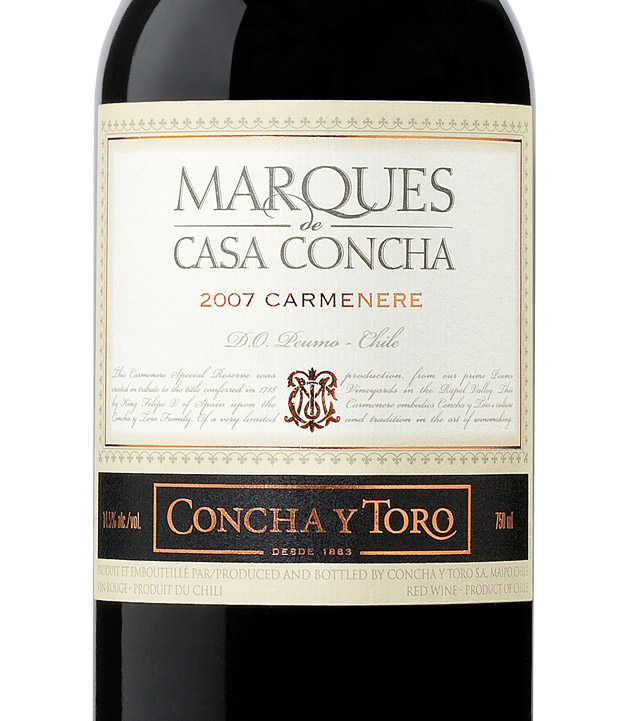
Wine of the Week: Concha Y Toro Marques de Casa Concha Carmenere 2007

OK, the names seem to be getting even longer.  Sorry.

But do try this 90% Carmenere / 10% Cabernet, the debut vintage of the line, which I tasted with the winemaker in 2009 shortly after its release.  Even then it was already drinkable, and it’s only gotten better: a deep purple, rich, blackberry and plum treat, well balanced, with ripe, chewy tannin and a wonderful finish.

You can find this wine at about $18-21.  It’s a little above the range of wines I typically recommend, but worthy every penny. And the 2008 and 2009 are also outstanding if you can’t lay your hands on an ’07.


Wine-ing Aboard Royal Caribbean’s Explorer of the Seas

I’ve just returned from a 9-day cruise on Royal Caribbean’s Explorer of the Seas, a 137,000 ton, 1,020 foot-long behemoth that’s still, amazingly, two rungs down on the cruise line’s size chart.

Beyond the ocean breezes, Red Stripes and frou-frou drinks on the pool deck, nine days without the constant annoyance of a BlackBerry, and the chance to read both The Billionaire’s Vinegar and The Widow Clicquot: The Story of a Champagne Empire and the Woman Who Ruled It on my new Nook eReader, the highlight of our trip was our nightly dinner at 8:30, and the very pleasant surprise of a really nice wine list!

Before the cruise I was dreading what appeared to be a crappy wine list, based on an almost cynically-chosen bunch of wine packages, laden with mediocre and uninspired choices, including a bunch of sweetish Chardonnays (over which I’d prefer a certain warm, recycled and amber-colored liquid drunk directly from a dirty boot).

Don’t get me wrong, the packages never got any better even with the ocean views from an elegant dining room on Deck 3. But the a la carte list was really nice, and over 9 nights we had a lovely dry Rose, two hearty reds and six refreshing and, according to the list, “Adventurous” whites. Even better, the wines were really reasonably priced, despite the fact that, well, 500 miles out to sea there really ain’t a lotta alternatives.

Now, these aren’t high-end wines by any means, except perhaps the Chateauneuf, but they were all delicious, satisfying, great values and in perfect condition and served by the best two waiters on the boat, Nicay “Captain” Morgan from Trinidad, and Reynaldo de la Torre from the Philippines.

I applaud Royal Carib’s Wine Buyer, whoever he or she may be, for putting together a fun, friendly and ‘fordable list when I least expected it. Here’s the lineup, which we matched with our dinner choices from an equally great menu:
  • Cline Cellars Viognier 2007
  • Sokol Blosser Evolution 2007
  • Zolo Torrontes Mendoza 2008
  • Vigne Regali “Principessa Gavia” Gavi 2007
  • D’Arenberg Adelaide “Stump Jump” White 2008
  • Chateau La Nerthe Chateauneuf du Pape Blanc 2007
  • Mas de la Dame Les Baux de Provence Rose 2009
  • Caliterra Arboleda Carmenere Colchagua 2007
  • Mandrarossa Nero d’Avola Sicilia 2007

Well done, folks.  Bon Voyage!


Free the Garden State Grapes!

New Jersey is the fifth largest state in the union for wine consumption (source: Adams Wine Handbook 2007) but one of only 13 states that continue to ban winery to consumer shipments.

More than 80% of the U.S. population already has access to direct shipments of wine and New Jersey residents should, too.

BUT two bills, NJ Assembly Bill 1702 and NJ Senate Bill 766, may pave the way for dramatically improving access to wines from across the U.S.  AB1702 is identical to SB766, which passed the Senate on March 11, 2010.

Both bills are based on the model direct shipping bill, now the legislative standard used by most U.S. states for legal, regulated direct-to-consumer shipments of wine.  These laws satisfy consumer demand and safety requirements, and create a new source for state tax revenues.

CLICK ON THIS LINK and tell your legislators to give us the rights enjoyed by residents of dozens of other states!


Wine Shorts – March 5, 2010

The Washington Post points out the growing influence of women on the world of wine, including many winemakers such as Cathy Corison, whose Napa Cabernets I consider to be among the best in all of California.
If you fly frequently for business or pleasure, Business Traveller’s Cellars in the Sky Awards are for you, and include the best sparklings, whites, reds and sweet/fortifieds served at 35,000 feet. And if you’re tired of being stuck on the tarmac for hours at a time - with a good glass of wine or not - consider joining the Coalition for an Airline Passengers Bill of Rights. Really.

Speaking of flying and wine, Decanter has a brief story about flights resuming in Chile while winemakers assess their damage from last week’s terrible quake. And for my previous story about The Mondavis of Chile, go here. They really make some rockin’ wines, and we wish all of Chile a speedy recovery.


Wine Shorts, September 18, 2009


Study Shows Ratings Numbers DO Influence Tasting Experience

I’ve said more than a few times on WineFlair and elsewhere that wine ratings by “the big guys” (and gal) such as Parker, Robinson, Broadbent, Suckling etc. will obviously and hugely influence the views of people who taste those wines and know their scores in advance. In other words, someone tells you you’re about to sample a 95, and boy when you taste it, it really is!

A scientific team from a university in Zurich says they’re proved it and also that wine ratings have a consistent effect on people who are told scores after they taste. Basically, a bunch of wine-drinkers was separated into five separate groups before a blind tasting. One group was told beforehand that Parker had rated the wine 92, and a second group that he had rated the wine a meager 72. A third and fourth groups were told the scores (92 and 72 respectively) after they had tasted the wine but before recording their impressions. A fifth group wasn’t told anything.

The results weren’t what a lot of wine snobs or people who live by critics’ ratings want to hear: the group that knew the wine had a 92 Parker rating before tasting it uniformly thought it was quite a bit better than those who’d falsely been told 72. The “92 Group” also rated the wine better than those who were told after they had tasted it. The third and fourth groups showed a marked tendency to agree with the ratings when they were told afterwards, indicating that even those who were told that the wine was a 72 didn’t challenge that number though they were tasting a wine actually rated 20 points higher. What that means is simple: their taste perceptions may have actually changed by being told that low number!

In a post from a couple years ago, I cited a 2001 University of Bordeaux story that made a similar if slightly more subtle point. In the first of two tests, Professor Frederick Brochet invited a bunch of self-anointed wine experts to describe the flavors and aromas of both red and white wines he poured. One of these experts lauded the red for its “jamminess” while another talked of its “crushed red fruit.” What’s wrong with that? Well, it was really a white wine, tinted darkly with food coloring. Not one of the 60 “expert” tasters could tell!

The second test with a different group was even sneakier, in which ordinary and inexpensive red table wine was placed in a pricey Grand Cru-labeled bottle, and also separately in its original labeled bottle. In other words, a single wine was passed off as itself – and as a different, far superior wine. What happened here? Three-quarters of the experts there judged the “grand cru” as “complex, balanced and rounded,” while the vin de table in their view was “weak, light, flat and faulty”. They were the same wine.

The moral of the story is what I’ve been saying for years, and you’re probably sick of hearing it.

But I’ll say it again: don’t depend on wine ratings. Taste and decide what YOU like.

Chicago Wine Retailer Closes Two Big Stores

Sam’s Wines, a major wine seller in my former town, has closed two Chicagoland stores in just two months — the South Loop, closed in August and Highland Park just last Sunday. Maybe they were overextended; after all, the Highland Park location was an impressive 25,000 square feet with a wine lounge, party room, 50-seat demonstration kitchen and glassware room. But it was a pretty awesome place – at the wine bar, you were permitted to buy a bottle of wine, have it chilled (or not) and drink it right there with no markup! First Harry’s Velvet Room, and now Sam’s. Damn!

I started making my first large purchases (rather than a bottle of two at a time) from Sam’s big location in Lincoln Park, and was thrilled that I could order a case or two at 3 pm and have it waiting at my 40th floor apartment in Lakeview neighborhood at 6. It was probably the precursor of many of today’s giant wine warehouses, but even back then, in 1996, their service and wine knowledge was better than at most places,

even much smaller ones, today.

This ain’t good.

We Remember the People of Windows on the (Wine) World


Windows on the World was a great restaurant and one of the country’s premier wine venues – its patrons consumed 10,000 bottles a month from a 50,000 bottle cellar, choosing off a list with nearly 1500 selections.  The wine service, at the hands of people we know and respect today including Kevin Zraly, Michael Skurnik and Andrea Immer, was top-notch, and its prices were reasonable in a city known for outlandishly expensive wine lists.  And its “Cellar in the Sky” offered one of the city’s original wine and food pairing menus.Seventy-eight of its staff perished on that day, and we remember those who died there along with all the ther innocent victims of that senseless act of terrorism.  Every day they worked hard to make their customers happy, and they are sorely missed.


Wine Shorts

Prosecco gets a Promotion

The producers of Prosecco – that refreshing Italian sparkling wine made from grapes of the same name – are thrilled that the Italian government has elevated Conegliano-Valdobbiadene to Denominazione di Origine Controllata Garantita status, the country’s highest level of quality. Only 41 wine regions in Italy carry the D.O.C.G. rank.

Prosecco producers may now call their wine “Prosecco di Conegliano-Valdobbiadene” or “Prosecco Superiore” beginning with the 2009 vintage. And as we say in the Marine Corps, everyone moves up one.

Why? Because wineries in nine provinces outside the DOCG region currently producing Prosecco labeled “Indicazione Geografica Tipica” (IGT, two levels down on the prestige meter), have been raised to (DOC) status. That was the rank once formerly held by Conegliano-Valdobbiadene. Finally, winemakers located outside this new DOC area will not be allowed to make a wine and label it “Prosecco.”

What does this really mean? Not so much to you and me, but to the top Prosecco producers it means they got kicked upstairs and are getting the respect they deserve. Prosecco really is a wonderful sparkling wine, lower in alcohol than many others and very refreshing and crisp. It’s also a great value.

What (Grape)’s in a Name? A Place. Somewhere. Probably un-pronounceable.

We Americans tend to describe, discuss and select wines based on the variety(ies) – that is, the grape or grapes that go into them. Hey, I’d like a Cab from Sonoma or a Pinot from Oregon, right?

But that’s bewildering to most people who don’t follow wine closely and don’t exactly have time on their hands to memorize what grape goes with what location. And, well, some of these places are often impossible to pronounce and therefore impossible to remember, anyway.

Say, for example, you like Merlot but want to try one from France or Italy. Except in very rare cases, such as Christian’s Mouiex’s Merlot, it won’t say “Merlot” on the bottle. Or maybe you had an Australian Viognier from Yalumba Winery but want to try one from France.

What to do? At least three things.

First, you can download and save my Wine Grape Charts, that give you the names of the grapes (sometimes there are two, three or even four varieties in a wine) and their corresponding, weird-sounding places. It’s not exhaustive and not meant to be, but it will cover about 90% of the wines you’re likely to find in most retail stores. For example, it will tell you that Viognier wines – some of the best ones, anyway – come from a place in France called Condrieu and that’s what’s on the label.

You can also look on the back label, which is just what it says…a second label on the back of the wine bottle, that sometimes (but not always) lists the grape varieties in the wine, and sometimes even their proportions.

At left is a remarkably detailed one, showing that this wine contains 66% Cabernet Sauvignon, 13.5% Malbec, 10.5% Merlot, 5.5% Cab Franc and 4.5% Petit Verdot, the five classic grapes that go into a Bordeaux blend (despite the fact that this is Australian wine). They even tell you a bit about how the grapes were harvested and the wine was fermented. But to tell the truth, this is rare. Often you’ll just get some

Most importantly, you can also talk to your local retailer, who should be able to not only help you based on the grape varieties you’re looking for but also the style of wine – old world vs. new world; light, medium or full-bodied; fruit bomb or nuanced; spicy or mellow; sharp or soft; etc.

If you’re buying from knowledgeable people such as Brian Hammill of Brian’s Wine and Liquor Emporium, or Mark Censits of Coolvines – two great NJ retailers – you’ll be talking to experts who’ll help guide your choices. If you go somewhere else and get a blank stare followed by a mumbled such as “well, it’s fruity with a real grape taste” then I suggest you drive away and find Brian or Mark.


Wine Shorts – July 10, 2009


SAVOY AIN’T JUST A HOTEL IN LONDON

The Savoie region of France isn’t well known among wine drinkers in this country. Heck, it’s not well known in France, either, as far as I can tell.

Still, it’s a place that produces interesting, if sometimes quirky wines, a stone’s throw from the Swiss border and Lac Leman (Lake Geneva). The wines, mostly white, are made from Altesse/Rousette, Chardonnay, Chasselas, Jacquere and Rousanne grapes. They also make some light and lively reds mostly from Gamay (the Beaujolais grape) and Pinot Noir, and Rose from Gamay.

Since this is a wine short, I won’t get into all the AOC stuff. I’ll just say that the whites, especially the Jacquere – the name of the wine as well as the grape, unique to Savoie – are really the standouts. Jacquere can produce a very dry, fresh, minerally wine with pronounced floral characteristics.

IS THERE AN OLD ZEALAND?

I’ve been drinking a lot of New Zealand wine lately, and not just Sauvignon Blancs but also some pretty nice Chardonnays, Pinot Noirs and even Rieslings. For example, earlier this week I tasted Torlesse Waipara Riesling 2007 and was more pleasantly surprised that I can say. Nice and dry, too. Americans need to drink more Rieslings, and more NZ wine!

Speaking of NZ, I’m having a typical Friday night dinner – a grilled cheese with bacon, accompanied by a chilled glass of Cuvee Number 8 Sparkling Wine, from New Zealand’s No. 1 Family Estate. This non-vintage wine in the blanc de noirs style is remarkably good, blended from Chardonnay and Pinot Noir, with only a hint of strawberry, lots of toast and green apple, appealingly dry but not austere. Really good stuff.

And to answer the question, yes, the “old Zealand” is just “Zeeland”, the Dutch word for “sea land,” referring to a coastal strip of land and islands bordering Belgium. NEW Zealand, logically enough was discovered by a Dutch seaman named Abel Tasman, who also gave his name to nearby Tasmania.


Wine Shorts


A PORT BY ANY OTHER NAME – STILL AS SWEET?

A lot of US-made wines carry European place names, and Port is one of them. But as European countries and the EU (European Union) have ramped up to protect those names in international trade, American producers see their brand names and brand recognition threatened, with good reason. If an American producer can’t call its wine “Port” anymore, substituting “Sweet red dessert wine made in the traditional Portugese style with four noble grapes” probably won’t work so well, either. So, what to call these wines, that the TTB (the US regulatory agency for wineries) will allow? Wines & Vines magazine covers the issue and talks to some California winemakers dealing with the problem.

PROSECCO GRANTED D.O.C. STATUS

A larger area that produces Italy’s sparkling wine Prosecco (made from a grape of the same name) has been granted DOC status by the Italian government. As in Champagne, only sparkling wine from this newly-designated region may be legally labeled “Prosecco” beginning August 1st. Prosecco is produced using the Charmat (bulk) method as opposed to the Champenoise method, so it needs to be drunk very young – under two years – and it won’t ever have the lasting fizz of Champagne. Not to worry; it’s a wonderful, refreshing wine nonetheless.

TENNESSEE JOINS NY AND NJ TO CONSIDER WINE SALES IN GROCERY STORES

On March 24, committees of the Tennessee legislature will hold a “study session” to consider allowing grocery and convenience stores to begin selling wine. New York and New Jersey are also looking at similar bills…and there’s a lot of contention around them all. Wine and liquor stores generally oppose these laws, but small wineries in particular seem to welcome them. Their view is that grocery stores represent potential new markets, because they are often ignored by retailers and distributors. And while consumers may benefit, how many small grocers and convenience store operators will have knowledgeable wine staff? The decisions of these lawmakers will surely make some people happy and many others, well, whine.


Wine Shorts


Find Your Lost Wine

Had a great wine somewhere but don’t remember the name, or where it was from, or the winery? Well, winelabelworld.com has a collection of labels, sorted by country, style, wine color and other distinguishing features. Find the one you’re missing, or add your own.

Irish Wine? No Way.

Way! I’ve had Mead, which is really not wine at all, and really…sweet and disgusting if you ask me. Sorry. But Ireland now has a real winery making authentic, and from all accounts, quaffable if not transcendent (!) table wines including Sauvignon Blanc, Cabernet, Merlot and Chardonnay. This is the day to read about the winemaker, here.

Miles’ Merlot Makes a Move…Upward!

If you saw Sideways, you know that Miles didn’t want to drink any “f***ing Merlot!” He had good reason. As the WSJ Online points out, way too much American Merlot has been, well, lousy – sweet, over-oaky, reeking of vanilla, and flabby; that is, lacking the acidity needed to taste fresh and to keep your mouth as well as your nose interested. Some producers are doing something about that, even at the <$10 price point, a real sweet spot in a down economy. Napa’s Charles Krug winery is singled out for recognition, although its offering is closer to $20. Have a look.

A Rosey Future?

Except for Champagne and sparkling wines, French wine laws (and they got a lot of ‘em) prohibit making rose wines by adding a bit of red to a white base wine. The same holds true across the European Union (EU), and popular wisdom is that that’s a good thing – superior rose wines are made from red grapes, with the juice held on the skins for as little as a few hours. But there’s a rule in the works in Brussels to change that, which supposedly would open the market to a lot of inferior plonk, and the French in particular, are seeing red about it.


Wine Shorts


Wine News (the magazine)

After a couple of email requests, a FedEx box filled with Wine News magazines arrived last week, much to my surprise and delight.

It’s a nice magazine, built on extended features illustrated with great photographs; extensive (maybe too extensive) coverage of wine auctions around the country; long and well-written profiles of wineries, winemakers and their grapegrowers, the often unsung heroes of this art; and of course tasting notes with obligatory 100-point scores. The Buyline section mimics buying guides in The Wine Enthusiast, Decanter and other consumer wine pubs, but doesn’t have enough value-priced selections in my view, although as the economy continues to tank I suspect the editors may change that. Thoughtful editorials and wine news “vignettes” share space with trade ads that are consumer-oriented, as fits the style of the magazine. All-in-all, a well-done publication – my principal complaint is that the headlines use a typeface that looks like it’s a bit squashed, and the body type is just too small.

U.S. Wine Exports grow 6% to above One Million, er, One BILLION Dollars!

The CA-based Wine Institute reports that U.S. wine exports, 90% from California, passed a billion dollars for the first time in 2008, up 6% from 2007. For more info on this pretty big development, go here.


Nose in the Glass, not in the Air

Wine writers too often write tasting notes that, well, smell. Of snobbery. And silly, flowery descriptions that make us laugh…or something else. A fellow wine writer dissects the trend as he returns from a writers’ symposium.

Trading Down…to the Good Stuff!

Most of us are even more aggressively dropping our sights out of the $20 range down to the under $15 category, and more, as the recession continues to loom over us like torrential rain a month before harvest. You don’t have to drink plonk at that price, either, as Laurie Daniel tells us.